
Compare Effingham Property Values
The Effingham QPublic parcel card keeps land, improvement, and assessment fields distinct instead of merging them into one number. Georgia assesses taxable property at 40 percent of fair market value. Special rules apply to some parcels.
| Value | What It Is | Where |
|---|---|---|
| Fair market value | The assessor's January 1 estimate of full value | QPublic assessment card |
| Assessed value | Normally 40 percent of fair market value in Georgia | QPublic assessment fields |
| Last sale price | Consideration reported for a prior transfer | Deed, PT-61 trail, and sale row |
| Land and improvements | The assessor's component split for land and structures | QPublic value detail |
Assessed value is a statutory calculation. It is not a second estimate of what a property would sell for. Exemptions shrink the taxable amount after assessment rules apply. A last sale can mislead too. It may be non-market, partial, family-related, corrective, or tied to a parcel that later split. Compare the deed and its legal description before treating a sale row as a market benchmark.
Date Effingham's Assessed Value
Georgia law sets January 1 as the valuation date for property across the state. That date anchors the assessment year in Effingham County. Sales, construction, or market shifts can come months later. The Effingham Board of Tax Assessors determines fair market value. It also keeps parcel characteristics current. The Tax Commissioner then bills and collects once values, exemptions, and millage rates are applied.
This split matters. Ask the Assessor about a parcel card. Also ask about a land or improvement figure, classification, or an assessment notice. Ask the Commissioner about a posted bill, a payment, or collection status. The Effingham Tax Assessor page is the official starting point for value questions.
Read Effingham Value Fields
Record the year before copying any number. Then capture total fair market value, land value, improvement value, assessed value, exemption codes, and taxable value exactly as labeled. Add acreage, building details, use class, and legal description. Those facts explain why two nearby parcels differ.
Land and improvement figures are appraisal inputs, not separate price forecasts. A vacant tract carries only land value. A developed parcel splits the roll estimate. Changes in square footage, use, quality, condition, or acreage can shift the record. When a physical characteristic is wrong, document the mismatch with the Assessor rather than adjusting the published figure yourself.
Compare the same field across years. Mixing fields invites error. Never set one year's assessed value beside another year's fair market value and call it growth. Watch for parcel splits, combinations, new construction, exemptions, and classification changes. Each can create a sharp swing unrelated to broad appreciation.
Estimate an Effingham Property Value
Use one parcel and one tax year throughout. The parcel ID is the anchor. It keeps the assessment, map, deed, and sale record connected when an address is abbreviated or a postal city differs from the legal jurisdiction.
- Search the address or parcel ID in Effingham QPublic.
- Record the tax year, fair market value, assessed value, land, improvements, and exemptions.
- Check the recorded deed and PT-61 trail for the last transfer's consideration and qualification.
- Compare like parcels only after checking acreage, use, structures, date, and parcel changes.
- Assessed value
- The statutory percentage applied to fair market value before exemptions.
- Fair market value
- The assessor's estimate for the annual tax roll, measured as of January 1.
- Level of assessment
- The ratio between assessed and fair market value, generally 40 percent in Georgia.
Test Effingham Sale Prices
The QPublic card may show sale history. But the recorded deed and the PT-61 real-estate transfer declaration carry the real transaction trail. Search the Effingham Real Estate Records portal by grantor or grantee. Match the legal description, book and page, dates, and consideration.
A county agenda packet offers a warning. One sample parcel shows a later market-looking sale. Beside it sits an earlier zero-price row with different reason and qualification codes. Zero does not mean worthless land. It can signal a non-market conveyance. A multi-parcel sale likewise cannot be assigned to a single parcel without reading the deed.
Compare Effingham Sale Evidence
A useful comparable should resemble the subject in location, use, land area, improvements, condition, and transaction date. Confirm the transfer was arms-length. Confirm the deed covered the same parcel count behind the recorded price. Qualification codes and PT-61 details can warn that a visible number is not ordinary market evidence.
Effingham's mix of older rural tracts, railroad towns, highway corridors, subdivisions, and industrial growth makes simple neighborhood averages risky. A metes-and-bounds tract and a platted lot can sit near each other with different utility, access, and development rights. City jurisdiction may differ too. So can zoning, flood context, and services.
Write down why each sale was kept or rejected. A transparent comparison beats a long list of prices. Notes help. County assessment data can frame the question, but a licensed appraiser applies current inspection and market judgment when a formal opinion of value is required.
Audit an Effingham Value Comparison
Check the parcel first. Every row should cover the same parcel or document a change such as a split. Line up acreage, legal description, land use, building area, and tax year before drawing any trend.
Label your sources. QPublic is the assessment source. The Clerk's deed index and the PT-61 trail anchor the transaction record. GIS adds location context but no appraisal. The Tax Commissioner covers billing and collection, and mixing fields across these systems without labels can turn accurate records into a wrong conclusion.
Check the math separately. In the ordinary Georgia pattern, assessed value is 40 percent of fair market value before exemptions affect taxable value. A mismatch may reflect a special classification, exemption, partial interest, or data issue. Ask the Assessor for the record's explanation. Do not force it into the ordinary formula.
Report ranges when evidence is thin. One prior sale, a nominal transfer, or a nearby parcel with different improvements cannot establish today's market price. Stronger conclusions use several qualified transactions, current property facts, and professional judgment. Match the certainty of the claim to the strength of the evidence.
Separate Effingham Taxable Value
Homestead and other exemptions can cut the taxable figure without touching the assessor's estimate of fair market value. Effingham materials identify homestead codes including S1, S3, SC, S4, S5, and SS. Eligibility and effect differ. Read the code on the current card. Confirm its meaning with the Assessor.
April 1 is the county's filing deadline for exemptions and returns. That date does not create a new market opinion. For bill calculations, due dates, delinquency, or payment status, continue to Effingham property tax records.
Explain Effingham's 2026 Values
A 2026 Tax Commissioner notice says homeowners may see roughly 30 percent lower property-tax bills through combined millage relief, while a separate county notice covers the September 1, 2026 millage-rate setting and links a five-year history. Neither notice proves values fell. Lower bills are not the same as lower assessments.
Taxes combine value, exemptions, and levy rates. A lower rate can cut a bill while the parcel's value stays flat or even rises. Use the Tax Commissioner notice for collection context. Then return to QPublic for the property value itself. That distinction keeps a tax-policy headline from becoming an unsupported real-estate claim.
Challenge an Effingham Assessment
An assessment notice opens a 45-day appeal period. Georgia's PT-311A appeal form supports the state process. Compare the notice against the parcel card, property characteristics, photographs, land size, improvement data, and genuinely similar sales, since correct facts often matter as much as the final number.
File with the local office by the deadline shown on the notice. Keep proof of delivery. A private appraisal or a documented arms-length sale may inform an appeal, though the exact evidence depends on the dispute. Remember what an appeal is. It reviews the assessment, not a deed's sale price.
Track Effingham Values by Year
Build a year table. List fair market value, assessed value, land, improvements, exemptions, and taxable value. Note the January 1 date. Add any sale, construction, split, or combination near the change, which shows whether movement came from the base estimate, a property fact, or an exemption.
Keep bill totals out of the table unless clearly labeled. Millage can change while the assessment holds steady. Exemptions can change taxable value without moving fair market value. A transaction can occur after January 1 and still appear in that year's sale history, even though the annual valuation was already fixed.
Request older cards by parcel ID and year. The office can supply identified assessment or digest records that are not online. Historic tax material may support a longer trend. Values from past systems need their original labels and context, so never convert them with a modern ratio unless an official source supports that treatment.
View Effingham's Value Source
The official Tax Assessor page names Effingham's appraisal office.
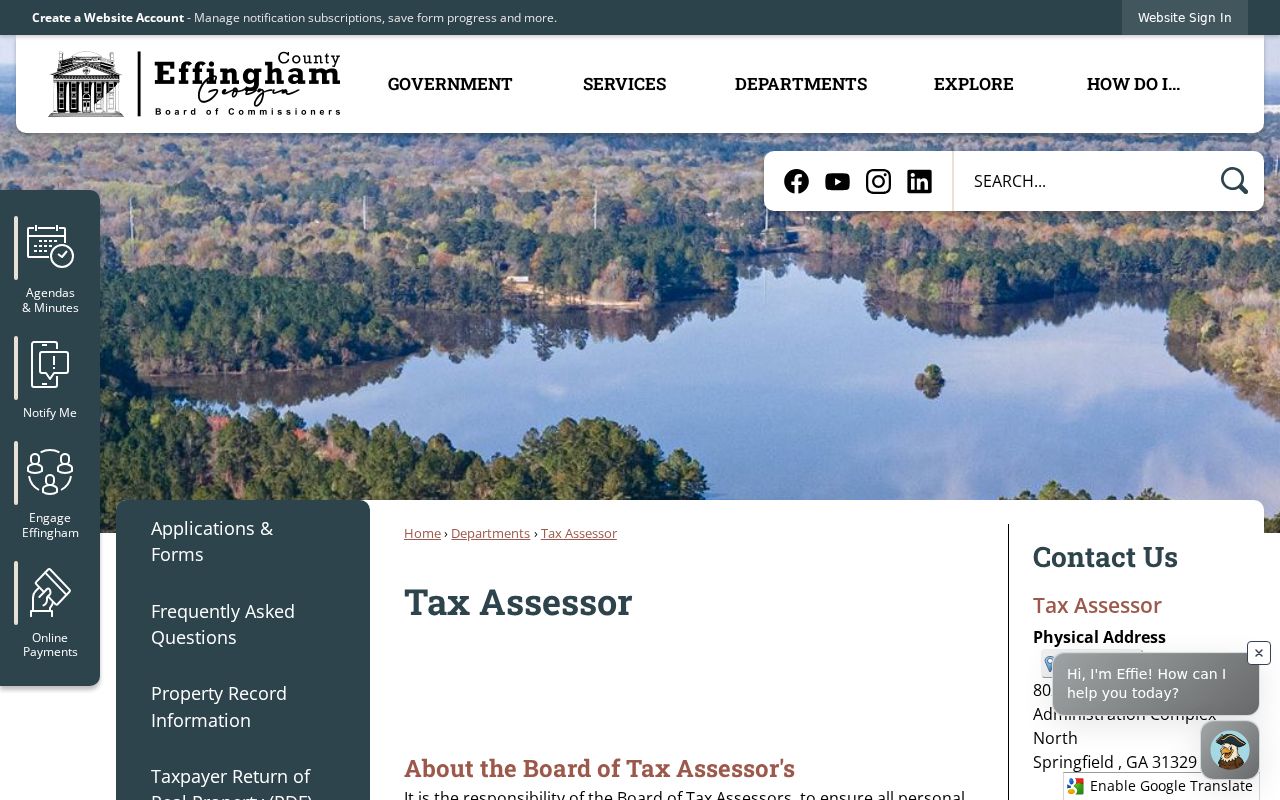
Use its QPublic link for parcel-level values and office help.
Request Effingham Value Records
The Tax Assessor sits at 802 S Laurel Street in Springfield. Requests can go online, in person, by phone, by email, or through a formal records request. Call 912-754-2125 with the parcel ID, address, tax year, and the exact field you need. The Clerk is at 700 N Pine Street, Suite 110. That office holds deeds and PT-61-related transaction records. It offers an online index, a public terminal, images, and certified copies at 912-754-2118.
The Georgia Open Records Act covers these requests. You can ask for an existing card, digest entry, notice, or other identified record. The agency generally responds within three business days. The response brings the record or an explanation of any delay, cost, or exemption. It does not have to create a custom appraisal or a new comparable-sales analysis. Older digest material may require a visit to the office, archives, or library.
Limit Effingham Value Conclusions
An Effingham County assessed value exists for one purpose: tax administration. It is not a promise of what a buyer will pay. It is also not a lender's appraisal, a replacement-cost estimate, or a title opinion. GIS linework helps with location context, but a survey it is not. Even last-sale data in the property records records an earlier event. That transfer may have been non-market or covered multiple parcels. Before any sale decision, weigh current condition, rights, acreage, legal description, and market evidence. Bring in a qualified appraisal when the stakes call for one. Save the source and access date for every figure you use. Property records change over time. Numbers from different years should never be presented as if they were measured on the same day.
Label every conclusion with its field name and year. Say fair market value for the assessment year. Say assessed value under Georgia's level. Say taxable value after exemptions, or consideration from a dated transfer. The vague phrase "the value" fails when several figures sit on the same screen. Clear labels keep a tax record from masquerading as a current sale appraisal. For insurance, lending, litigation, or a sale, rely on the valuation professional. Rely on evidence suited to that decision. The public card still earns its place. It supplies a consistent official baseline. It identifies the assessed parcel and its parcel number. And it shows which facts deserve a closer look before you order more detailed work.
Value vs price. An Effingham assessed value is not a forecast of the next sale. A Georgia-licensed appraiser provides a property-specific market opinion when one is required.