
Identify an Effingham Property Owner
Who owns an Effingham County property? The tax roll answers first, and the deed record confirms it. QPublic is built around an address, an owner name, or a parcel ID. Any of the three works as a starting key. Its parcel card can display the tax-roll owner, mailing and physical addresses, the map or parcel number, acres, class, assessed value, legal description, and sale history. Together those fields build a working identity for the land. They are still not evidence of title.
- Enter the physical address in Effingham County QPublic. Copy the Owner field, parcel ID, physical address, mailing address, and legal description exactly.
- Search that owner as a grantee in the Effingham Real Estate Records portal. Match the newest conveyance to the same legal description or book and page.
- Check whether a newer deed names another grantee. The tax roll and the recording system update on separate tracks, so compare dates instead of assuming both screens changed at once.
- If the owner is a company, trust, or estate, keep the exact capacity shown. An entity filing or probate record can explain the name, but it does not replace the recorded deed.
This route rests on two official sources, which is its strength. An address search can fail. When it does, find the polygon in the county GIS map. Capture the parcel number. Then run the QPublic search again. Rural road formats, missing situs addresses, splits, and recombinations often cause trouble. The parcel number is often a far better key than the street.
Read Effingham's Owner Field
On the assessor card, Owner means the name on the county assessment roll. Mailing Address is where the tax bill goes. The physical or situs address marks the land itself, and all three values can differ. An absentee-owned tract may route mail to a post office box. An LLC parcel or trust-held land may route mail to a business office, an attorney, or a trustee. Copy the name exactly as written. Chase surname variants for a person. Chase the full legal style for a company or trust. The parcel ID is the control field when common names return several results. Homestead data may show that an exemption was claimed. It never proves the named person occupies the property today. The QPublic landing page is the right place to begin. Start an Effingham County property owner search there.
Every route through the portal, whether by owner, address, or parcel, ends at the same parcel card. That card must then be checked against the latest deed before you treat the owner line as final.
Effingham Ownership Record Sources
No single screen settles every property owner question. Each Effingham County source serves a different job, and the access channel matters whenever a portal cannot locate the land.
| Ownership Source | What It Adds | How to Reach It |
|---|---|---|
| Board of Tax Assessors | Current roll name, mailing and situs addresses, parcel ID, values, exemptions | QPublic; office or phone request |
| Superior Court Clerk | Recorded grantee, deed date, book/page, legal description, later claims | Free Tyler images; GSCCCA; counter; written request |
| County GIS | Parcel location and the ID that links map to card | Interactive GIS; GIS office assistance |
| Georgia SOS | Entity status, registered agent, officers where filed | State business search |
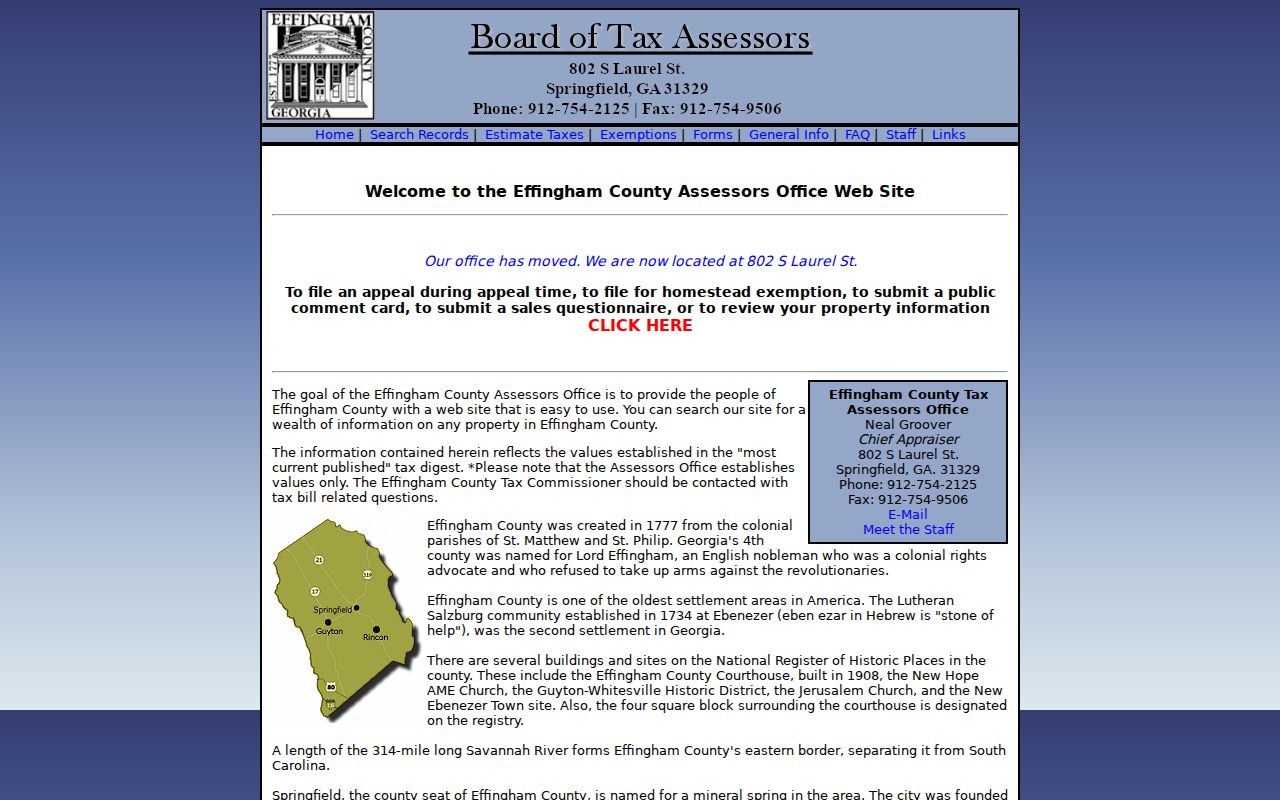
The Tax Assessor sits at 802 S Laurel Street in Springfield. The office answers the phone at 912-754-2125. The Clerk is at 700 N Pine Street, Suite 110. Its real-estate line is 912-754-2118. Both offices hold records that a first online query may never surface. When a file is not online, give the custodian the parcel ID, the address, the names, and the document type. Add a date span as well. Ask for an existing electronic record before anything else. Georgia's Open Records Act normally requires production or a written response within three business days. Retrieval, redaction, or copying charges may apply.
Confirm Effingham's Latest Grantee
A recorded deed names the grantee who took the conveyed interest. Search the QPublic owner as grantee first. Open the newest matching deed image and compare its legal description against the parcel card. Then search the same person or entity as grantor. A later conveyance may have moved the interest onward. Spouses, trustees, estates, and companies can all appear in roles. A single tax-roll line never summarizes those. Effingham's Tyler portal reports separate current-through dates for deeds, liens, and plats. That helps you judge index freshness. Its landing material does not state the earliest online year. Older or missing records live in the Clerk's public terminal and deed books, the statewide GSCCCA search, a written records request, Georgia Archives microfilm, or the Effingham Public Library Genealogy Room. The detailed process for a single instrument belongs with the county's deed records. Here the deed serves one focused purpose: checking ownership against the most recent recorded conveyance.
Trace Effingham Entity Owners
An owner line may name an LLC, a trust, an estate, joint owners, or a life-estate holder. Preserve that wording exactly. For an LLC, search the precise name in the Georgia Secretary of State Corporations Division, where entity status, a control number, a registered agent, and officer data can identify the right company. The registered agent is not the landowner. The agent's address is not the parcel location. For a trust, read the deed's capacity language and note any trustee named. For an estate, tie the assessor entry to the Probate Court file and any executor or administrator deed recorded with the Clerk. A death certificate or obituary documents an event, but neither transfers real property. Separate same-name people with the mailing address, parcel ID, deed parties, and legal description.
- Owner of record
- The name carried by the assessor or recording system for its stated purpose.
- Grantee
- The party receiving the interest described in a deed.
- Title
- The legal ownership interest, which a simple public lookup cannot certify.
- Situs address
- The physical location of the parcel, not the address used for tax mail.
Watch Effingham Deed Filings
The Effingham real-estate portal offers a fraud-notification option. A free account unlocks it. When a watched name shows up in a new deed filing, the system sends an alert. Treat that notice as a prompt, not a verdict. Pull the official deed image. Compare the instrument number, book and page, party names, date, and legal description.
Deed-copy mailers and urgent mortgage notices can imitate official correspondence. Before paying or replying, call the Clerk at the published office number. Confirm the cited record exists. Portal images of recorded instruments are free. Certified and paper copies follow the Clerk's current fee schedule.
Note: A filing alert flags new deed activity in Effingham County records. It cannot track unrecorded claims or replace legal advice about title.
Protected Effingham Owner Records
Georgia law lets certain owner details stay hidden, and Effingham's Tax Assessor publishes a non-disclosure form for that purpose. It covers certain protected public-safety and government roles. Applicants list property names, address, and parcel number. Proof such as a badge or agency letterhead is required too. It is not a blanket opt-out for owners.
The form allows a notarized or in-person release later. Georgia Safe at Home offers eligible victims a substitute address and mail forwarding. A blank Owner field means nothing by itself. Ask the assessor what official confirmation it can give without exposing protected data.
Limits on Effingham Owner Answers
An assessor name is not proof of title. A deed index hit does not mean every claim is resolved. A deed may convey only part of an interest. Life estates, easements, liens, probate orders, corrected deeds, and unrecorded claims can all change the legal picture. The parcel card cannot tell you who lives there.
Public ownership data still serves purchase checks, estate and heir research, boundary questions, fraud detection, and civic review. For a binding answer, get the instrument itself and consult a title professional or attorney. Hire a licensed surveyor for a boundary. The tax map will not settle it.
Lawful use. Effingham County owner records are for lawful research and due diligence. Never use them to stalk, harass, threaten, trespass against, or harm any person.