
Search Effingham County Property Records
Three official systems carry the load. The Effingham QPublic property search ties an address, owner and parcel ID to the assessor's tax card. The Clerk of Superior Court's Tyler real-estate portal indexes deeds, liens and plats. And the county GIS page opens parcel maps along with other geographic layers. Start with the fact already in hand. An address suits QPublic or GIS. An owner name fits QPublic and the deed index. An exact parcel ID is the strongest bridge between the tax roll and the map.
These sources answer different questions. A tax card names the assessed owner and current values. A recorded deed names a grantor, the party conveying an interest, and a grantee, the one receiving it. GIS places the tax parcel on the ground. No single system proves clear title, settles a legal boundary or sets a market appraisal, so compare identifiers and legal descriptions before treating two results as the same land.
- Find the assessor card by street address.
- Copy the parcel ID, owner spelling and legal description.
- Search the Clerk's index for the latest deed and any relevant liens.
- Open the same parcel in GIS and compare the recorded plat.
- Ask the custodian for certified or older records when the online path stops.
Effingham County Records Custodians
Three offices in Springfield split the work. The Clerk of Superior Court records land instruments and keeps their index. The Board of Tax Assessors handles parcel cards, classifications, exemptions and annual values. The Tax Commissioner bills and collects. Aim a value appeal at the collector or a payment question at the assessor and the answer stalls. Know which record you need before contacting any office.
Clerk of Superior Court
700 N Pine Street, Suite 110
Springfield, GA 31329
912-754-2118
Effingham County Tax Assessor
802 S Laurel Street
Springfield, GA 31329
912-754-2125
Effingham County Tax Commissioner
802 S Laurel Street
Springfield, GA 31329
912-754-2121
QPublic Connects Effingham Parcels
The assessor card is the natural first stop. Search by owner name, address or parcel ID. A match can show the owner, separate mailing and situs addresses, acreage, class or taxing district, exemptions, legal description, land and improvement values, maps or sketches, and sale history. The situs address locates the land itself. The mailing address only shows where notices go. That may be a post office box, a business office, a trustee or some other contact.
Copy the parcel ID exactly. Keep every letter, hyphen and trailing zero. Local IDs range from short numeric strings like 02940041 to long ones such as G008000000005000. A split or recombination can assign a new current ID while an older deed or plat retains the former number. Static county pages do not state the full search-field order or the timing of roll updates. Check a recent closing in the deed index too.
The county's Tax Assessor page lists the counter, phone and records-request path. Use it when a card will not load or historical annual information is needed.
Effingham Deeds, Liens and Plats
The Tyler portal posts separate data-through dates for deeds, liens and plats. Read all three before searching. That detail matters, because a docket current through one date may lag for another. Try spelling variants and both party roles whenever an owner name is involved. Grantor gives an interest; grantee receives it. Confirm each result through the recording date and instrument type. Check the book and page or document number. Verify the legal description too.
Not everything is online. The statewide Georgia Superior Court Clerks' Cooperative Authority offers another official route to real-property records. It covers grantor and grantee, book and page, plat and lien searches, plus PT-61 sale data. If an image or older index is absent, visit the Clerk during its posted weekday hours. Or send a written request. Include Effingham County, the address or parcel, party names, document type, date range and any known book/page reference. Ask for an electronic copy and a cost estimate first.
Freshness Dates Guard Deed Searches
The real-estate landing page does something a broad web search cannot. It separates how current each docket is. Read those dates before concluding that no filing exists. A deed recorded after the displayed cutoff may not appear in the result set. The portal publishes no earliest online deed year and no local imaging cutover. Assume no historic start date.
Older material follows a different path. The Clerk can point researchers to public terminals, deed books, older indexes and certified copies. The Georgia Archives county microfilm collection and FamilySearch offer a second route to historic books. Their catalogs run by county, book and year rather than a searchable owner name. Names rarely help there. A known book and page, a legal description or an adjoining-owner clue beats a modern street address. It wins every time.
Effingham Property Fraud Alerts
Effingham County's real-estate portal offers a fraud-notification service tied to a free account. It sits beside the deed search for a reason. Alerts draw on filings in the same recorder system. Register every name form that appears on your recorded documents. Then treat any alert as a cue to pull the instrument. Do not treat it as proof of fraud itself.
Suspicious deed or mortgage mail deserves a close look. Check the instrument number, book and page, and recording date against the official record. High-priced deed-copy mailers are not the county custodian. A notice claiming county authority should send you back to the official Effingham County website. The published office number there settles the question. Keep the letter, envelope, URL and payment request if fraud seems likely.
Effingham County Record Types
No single document answers every property question in Effingham County. The current tax card works well for owner and assessment research. The recorded deed supplies the legal transfer. A tax bill adds levy and payment detail. GIS places a tax parcel among roads, districts and other mapped features. Permits and zoning files round out the picture with approved work and land-use decisions.
| Record Type | What It Documents | Kept By | Access |
|---|---|---|---|
| Deeds | Transfers, parties and legal descriptions | Superior Court Clerk | Tyler, GSCCCA or Clerk counter |
| Mortgages and liens | Recorded claims and releases | Superior Court Clerk | Portal, terminal or request |
| Assessment and tax | Values, exemptions, bills and payments | Assessor and Tax Commissioner | Separate official portals and offices |
| Plats and parcels | Lots, tax geometry and map references | Clerk, GIS and Planning | GIS, recorded plat or request |
| Permits and zoning | Approved work and land-use decisions | County or applicable city | OpenGov, city files or records request |
Start with Effingham County deed records when you need a transfer chain. Turn to property tax records for assessments, exemptions, bills and appeals. Map and plat questions follow the parcel route instead. A court fight over title, partition, foreclosure or a lien may also pull in the Superior Court case file.
Read Effingham Parcel Maps Carefully
The county GIS map shows far more than parcel outlines. Its documented layers include zoning, future land use, roads, address points, aerial imagery, flood information, evacuation zones, railroads, streams, utilities and public-safety districts. Each layer has a limited purpose. A flood layer is planning information. Legal boundaries belong to the recorded plat and survey.
Open the Effingham ArcGIS hub and note the parcel's exact ID. Then compare QPublic for owner and value fields. Map prefixes like R225, G19 and S106 appear in county subdivision material. The county publishes no decoding key for them. Keep the code intact without assigning meaning to each character.
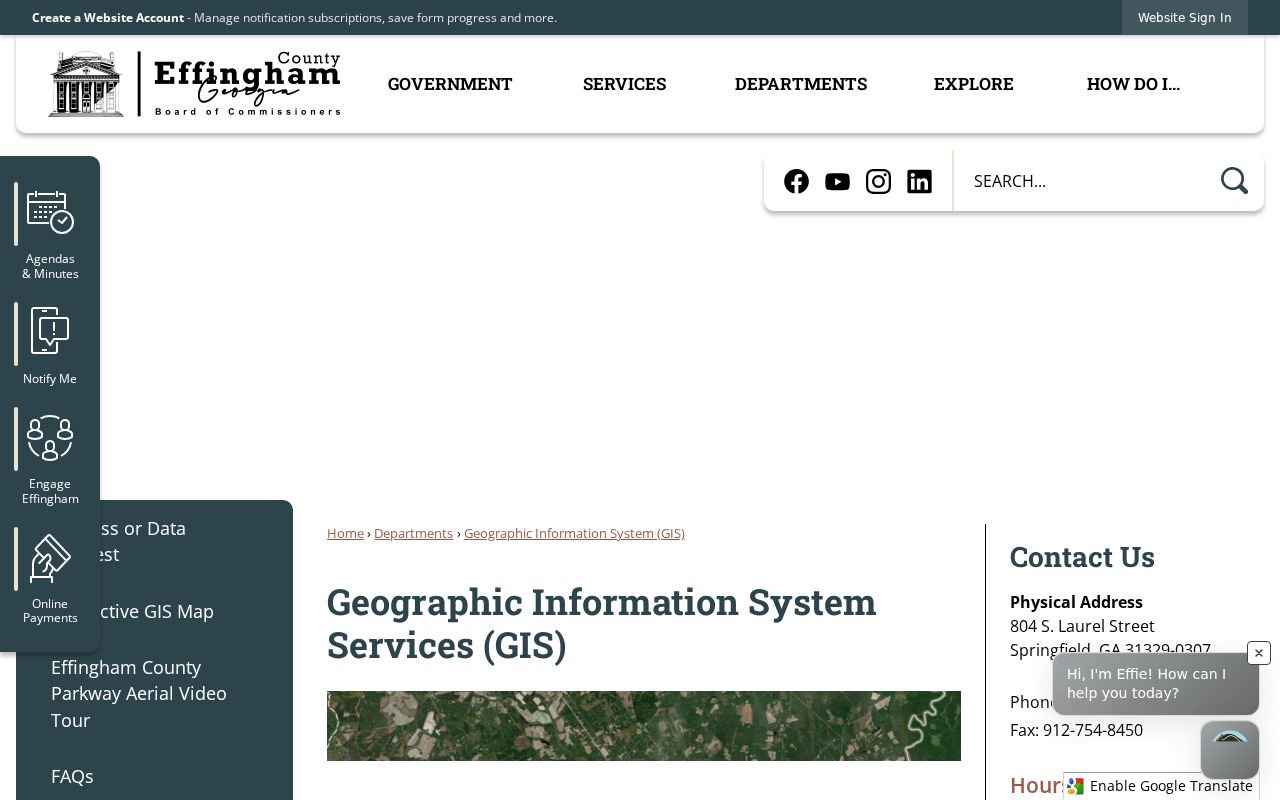
The county GIS overview is the official starting point for map services and contact information.
Georgia's Forty Percent Assessment
Georgia assessors determine fair market value as of January 1, then generally calculate assessed value at 40 percent of that amount. Exemptions can reduce the taxable amount further. Those are distinct figures, and none should be substituted for the amount due on a bill. The Tax Commissioner applies millage and handles collection after the assessor establishes the roll.
The Georgia PT-311A appeal form supports an assessment appeal, while Effingham's assessor supplies local notices and filing instructions. The county says appeal waivers can be mailed or hand-delivered to the assessor at 802 S Laurel Street; staff can also mail an appeal form or records-request form after a call. Use the notice's deadline and local directions. Do not assume that a payment dispute changes the underlying assessment.
Tax Relief Is Not Revaluation
A 2026 Tax Commissioner notice says Effingham homeowners may see roughly 30 percent off their property-tax bills through combined millage relief. That is a bill development. It is not evidence that market or assessed values dropped. The county also announced a September 1, 2026 millage-rate setting meeting under O.C.G.A. § 48-5-32 and posted a five-year millage history.
Keep the sources separate when comparing years. QPublic holds the assessor's land, improvement, market and assessed fields. The Tax Commissioner's official page covers billing, payment and current notices. A recorded deed or PT-61 supplies transaction consideration. A bill can move because of millage or exemptions even when the property card stands still.
Effingham Permits Follow Jurisdiction
Effingham County Planning and Zoning maintains zoning records and subdivision plats. It handles rezoning, variances, development plans, land-disturbance work and encroachment permits. The county planning page and the OpenGov service apply only where the county has jurisdiction. City property may sit in a separate municipal file.
Rincon publishes planning applications, including lot-line and annexation materials. Guyton supplies building, inspection and final-plat forms. Springfield offers no searchable municipal permit database. For a file that is not online, give the custodian a street address and parcel ID. Add the subdivision and lot, the applicant if known, and the permit or case number. Include a date range and the documents you want. Georgia's Open Records Act, O.C.G.A. § 50-18-70 et seq., frames the request. It covers existing public records.
Older Effingham Land Records
Modern parcel numbers only reach so far back. Deed research in Effingham County before those IDs existed means working across older courthouse books. It also means Clerk indexes, Probate and former Ordinary files, tax digests, plats, state microfilm and FamilySearch images. Springfield has held the county seat since 1799. FamilySearch documents Effingham court minutes from 1827 through 1922 on four microfilm reels. Only a partial index exists.
For pre-1900 material, the Georgia Archives recommends browsing by book. Do not count on a full name search. The Effingham Public Library Genealogy Room holds obituaries, city journals, yearbooks and gravesite photographs. It also keeps census and divorce sources, land records and family histories. These sources can explain a broken chain of title or identify heirs. They still cannot replace a certified recorded instrument. The 1908 courthouse and 1935 jail stand as record landmarks. No official proof supports the old claim that a courthouse fire destroyed Effingham deed books. Treat that story with doubt.
Rincon, Guyton and Springfield Records
Deed records, assessments, tax bills and county parcel maps all stay with Effingham County for the three incorporated cities. Municipal files add a separate layer on top. Rincon's Highway 21 growth and its annexations shape its paperwork. Guyton's railroad geography and rural western edge matter there. Springfield's county-seat role shapes which permit, zoning or boundary document matters.
A postal city never proves municipal jurisdiction. ZIP 31326 serves Rincon addresses. ZIP 31312 covers Guyton and nearby areas. ZIP 31329 reaches beyond Springfield. Recorded annexations include a 2019 Springfield parcel. The list also holds 2022 Rincon acreage and a 2006 Guyton entry tied to Pleasant Point. Check the current boundary in GIS. Then read the ordinance or plat before deciding whether to ask a city or the county for permits. Dedicated city pages cover Rincon property records, Guyton records and Springfield property records.
Limits of Effingham Property Records
Effingham County property records answer many questions. They identify the assessed owner of record, show recorded transfers and claims, document values and taxes, and place each parcel on a tax map. They cannot do everything. No record proves every interest is clear, establishes who occupies a mailing address, converts a GIS polygon into a surveyed boundary or sets a sale price. Protected fields may also be redacted. Effingham's assessor non-disclosure process serves only defined protected owners and requires badge or agency proof, so it is not a general opt-out.
When the answer carries legal or financial weight, get the actual instrument from the Clerk and consult the right licensed professional. A title company or attorney handles title questions. A surveyor marks boundaries. The assessor answers roll and value questions, while the Tax Commissioner confirms bills and payments.
Lawful use. Effingham County property records support purchase research, boundary work, estate matters and civic review. Georgia law can punish stalking, harassment, threats, identity theft, trespass and fraud; never use owner data to target or harm a person.