
What Effingham County Deed Records Convey
The Clerk of Superior Court serves as the recorder for Effingham County, entering deeds, mortgages, liens, plats, releases, and other real-estate instruments into the official deed records. A deed names the parties and describes the conveyance. Read it alongside its legal description, execution and recording details, and any referenced plat before drawing conclusions.
| Deed Type | What It Does | Common Use |
|---|---|---|
| Warranty deed | [Full ownership with guarantees] | [Standard sales] |
| Quitclaim deed | [Transfers whatever interest exists] | [Family, divorce, cleanup] |
| Grant / special warranty | [Limited guarantees] | [Some sales, Georgia custom] |
| Trustee / executor deed | [Transfer from an estate or trust] | [Probate, foreclosure] |
| Tax deed | [Transfer after a tax sale] | [Delinquent-tax properties] |
Instrument types matter here. A warranty deed conveys with covenants. A quitclaim transfers whatever interest the grantor may hold, with no promises attached. A security deed secures a Georgia loan. An executor's or administrator's deed may document an estate transfer. Liens burden property without conveying it, and a cancellation or release clears that obligation.
Inside the Effingham Grantor-Grantee Index
The Effingham Real Estate Records portal offers free public index entries and images. In 2026 its notices carried different current-through dates for deeds, liens, and plats. Filter each category separately. Search spelling variants and both sides of the transfer.
- Find the present owner's acquisition deed with that owner listed as grantee.
- Read the grantor, legal description, recording date, and book/page or instrument reference.
- Search that grantor as a grantee to locate the earlier acquisition.
- Repeat, checking plats and estate or court records when the sequence breaks.
- Grantor
- [The party transferring - the seller.]
- Grantee
- [The party receiving - the buyer.]
- Chain of title
- [The ordered sequence of deeds for a property.]
- Book/Page vs Instrument #
- Alternative references used to identify a recorded document; preserve exactly what the index displays.
Get an Effingham County Deed Copy
View the image online when one exists. Otherwise request a plain or certified copy from the Clerk of Superior Court, 700 N Pine Street, Suite 110, Springfield, GA 31329, 912-754-2118. Give party names, instrument type, and approximate date. Add book/page when known. Ask the current fee before ordering. No certified-deed price is published, so confirm the cost with staff.
At the counter, ask whether the public terminal exposes an index or image that the web search omits. A written request should distinguish a plain electronic image from a certified copy and identify the exact instrument. For an older volume, include the direct or reverse index reference and the legal description. Narrow requests help; staff cannot perform private title research.
Recorded, not guaranteed. The index shows what was accepted for recording; it is not a title opinion and cannot rule out unrecorded interests, indexing errors, or competing claims.
Search Fields Beyond a Party Name
Need a search field the local site does not offer? The GSCCCA statewide real-property system is a useful second route. It handles lookups by grantor or grantee, book and page, instrument, plat, lien, street, map, subdivision or lot. Transaction details are searchable too. Coverage spans a single county or the whole state at once.
| Grantor / grantee | Parties giving and receiving an interest |
|---|---|
| Book / page | Direct recorded-volume reference |
| Plat / subdivision | Map and lot context tied to a legal description |
| PT-61 / sale | Transfer-tax and transaction search clues |
Note: Search names broadly first, then narrow by date and instrument type; initials and entity spellings can hide an otherwise valid deed.
Effingham's Three Separate Data Clocks
Effingham runs three separate data clocks. Deeds run through August 31, 2026. Liens run through September 2, and plats through September 1. Because the clocks differ, a deed search cannot show whether a later lien or plat has reached the same update point, so note the date for the category you need. Open the live portal notices before each search.
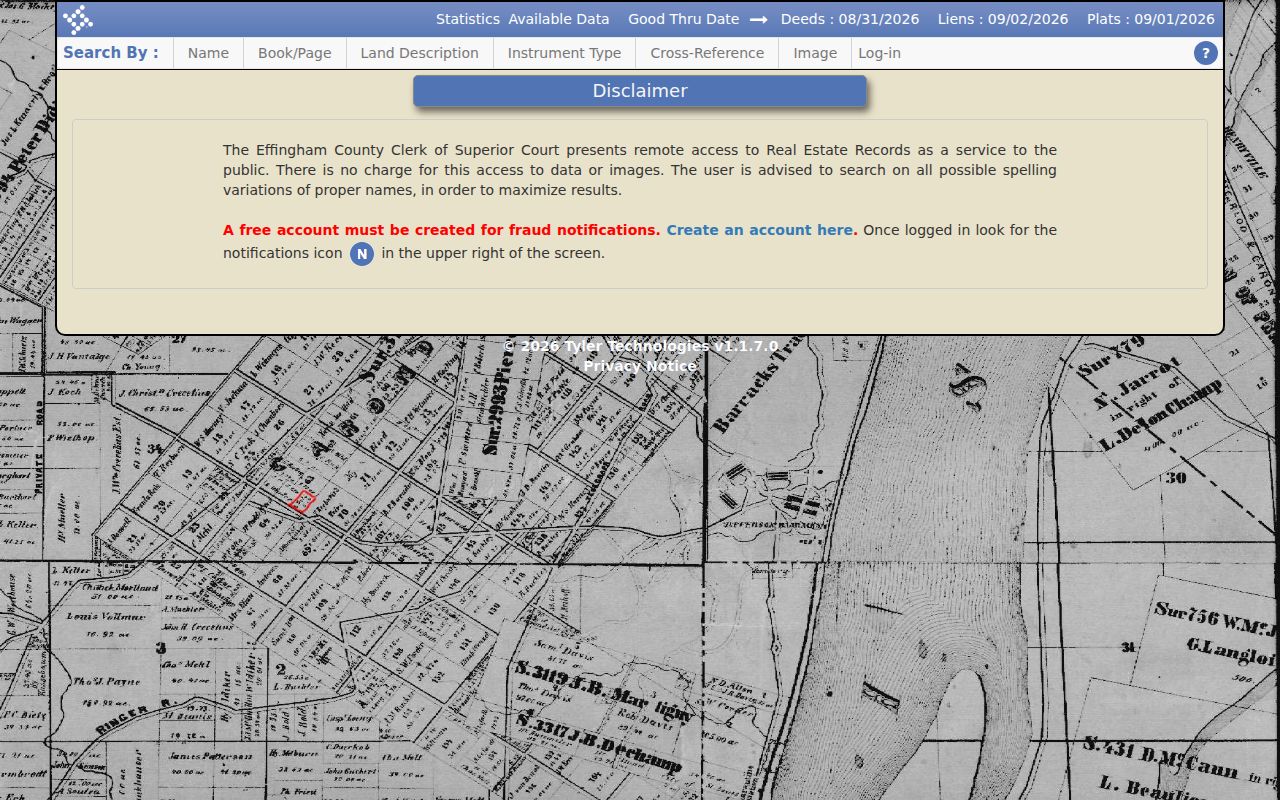
The landing view also offers a free-account fraud-notification option. Enrollment alerts a user to later name-based filings but cannot block them.
Older Effingham Deed Books and Historical Fallbacks
The local portal never states its earliest searchable year. When an online chain ends, ask the Clerk about older direct or reverse indexes, deed books, the courthouse terminal, or microfilm. The Georgia Archives point researchers to pre-1900 county records and county microfilm indexes. FamilySearch catalogs can identify filmed volumes too.
The Effingham Public Library Genealogy Room pairs land records with obituaries, city journals, yearbooks, gravesite photographs, census materials, and family histories. These sources explain the people behind an old deed. They cannot replace a certified land record. Use them for context, and return to the Clerk for the certified record itself.
Plats, Liens, and Deeds Must Be Read Together
A deed's lot-and-block shorthand often points to a recorded plat; pull that plat. A security deed, lien, cancellation, or release may explain later entries filed under the same names. Effingham's subdivision list maps local names to map-prefix strings. Those clues separate similarly named tracts.
For maps, see the Effingham parcel map guide. For a broad address-to-parcel lookup, use the property search workflow.
Counter and Written Deed Requests in Springfield
Keep each request narrow. Give the county and property address or parcel first. Add grantor and grantee spellings, deed type, and approximate recording date. Include any book/page or instrument number. Ask for an electronic plain copy first. If certification is required, request the current price and delivery options too. The Clerk's published hours are Monday through Friday, 8:30 a.m. to 5 p.m.
When a deed is neither searchable nor readily produced, Georgia's Open Records Act guidance explains the framework. Agencies respond within three business days. Permissible search and production charges, written estimates, or exemption notices may follow, but the procedure never requires an office to research a chain of title.
Probate and Court Events Can Break a Simple Chain
Not every change of ownership starts with a sale. In Effingham County, an estate deed, year's-support award, partition, quiet-title action, foreclosure, or tax deed can all reshape the property records. Each of these can break a tidy grantor-to-grantee sequence. Look first for the recorded instrument in the land index. The court file explains the legal event behind it.
Effingham Superior and State Court access begins through the Clerk. Statewide court links sit at the Georgia Judicial Gateway. A probate or court reference tells you why a new owner of record appeared. The recorded conveyance supplies the deed link itself.
Keep dates and case numbers close as you move between systems. That discipline keeps people with similar names out of one parcel chain.