
Read an Effingham County Property Tax Record
The Assessor's board sets value and rules on exemptions. The Tax Commissioner bills, collects, and disburses. Grasp that division first, and nearly every Effingham County property tax record reads clearly afterward.
| Field | What It Shows | Where |
|---|---|---|
| Assessed value | Value used as the tax base | Tax Assessor |
| Market / appraised value | Assessor's estimate of full value | Tax Assessor |
| Exemptions | Homestead and other approved reductions | Tax Assessor |
| Tax bill & status | Amount billed, paid or delinquent | Tax Commissioner |
| Taxing districts | County, school, city or special levy context | Tax Commissioner |
Georgia usually assesses at 40% of market value. A special statutory classification can sometimes replace that ratio, and neither figure equals a sale price. The final bill reflects assessed value, exemptions, taxing jurisdictions, and adopted millage. Take appraisal questions to the Assessor. Bring payment, delinquency, and tax-sale questions to the Commissioner.
Look Up an Effingham County Tax Bill
Find the parcel ID first through QPublic. Then open the county's GovernmentWindow payment portal. The screen answers a balance or transaction question well, but it is not a complete lien or title search.
- Locate the assessment parcel by address and copy its exact parcel ID.
- Open the Tax Commissioner inquiry and review the current bill, due amount, and payment status.
- Compare the exemption and assessed-value fields against the assessor card and notice.
- For delinquency, tax-sale, levy, excess-funds, or recorded tax-deed questions, call the Commissioner and search the Clerk's land index.
- Assessed value
- [Definition - the taxable portion.]
- Mill rate / levy
- [Definition - how the tax is computed.]
- Homestead exemption
- [Definition - owner-occupied relief.]
- Tax lien
- [Definition - claim for unpaid taxes.]
Appeal an Effingham County Assessment
An appeal clock starts with the annual assessment notice. The tax bill arriving later is too late. Georgia's uniform PT-311A form allows 45 days from the notice date, and Effingham documents an online QPublic route along with mail and hand-delivery options.
Protect the appeal window. File with the Board of Tax Assessors within 45 days of the mailed assessment notice; retain proof of timely submission and identify the parcel and contested value.
The Effingham Assessor's Public Record Channels
The county's Tax Assessor page explains annual returns, assessment notices, homestead filings, and appeals. QPublic accepts owner, address, and parcel searches. Expect the search screen to vary.
| Online | Current property card, value, exemption, legal description, map, and sale-history fields as available |
|---|---|
| Counter / phone | 802 S Laurel Street, Springfield; 912-754-2125 |
| taxassessor@effinghamcounty.org for office guidance | |
| Mail / hand delivery | Assessment appeal and supporting documents |
| Open-records request | Existing historical cards, notices, maps, or value-history records |
Specify the current card or a past tax year. An agency will not create a new valuation analysis. The county's official assessor guidance spells out the request details.
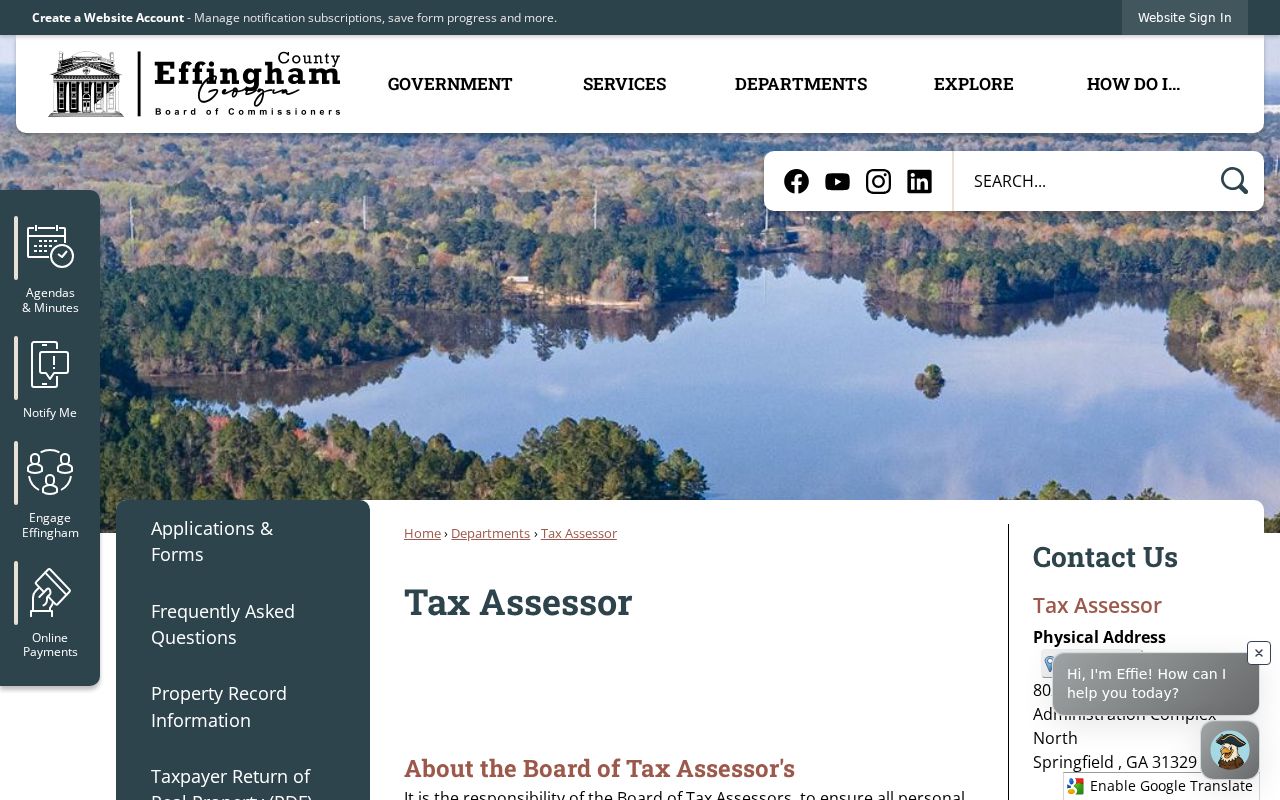
That page steers value, return, exemption, and appeal questions to the appraisal side of Effingham's two-office tax system. Payment matters belong to the other office.
Homestead Applications Have an April 1 Line
Effingham's homestead page lists local exemption codes S1, S3, SC, S4, S5, and SS. Each carries its own eligibility rules and paperwork. April 1 is the filing deadline. File by then for the exemption to affect that year's bill, using the county's online application or blank local application card.
Tax terms in plain language
Fair market value is the assessor's appraisal basis. Assessed value generally equals 40% of that in Georgia. A homestead exemption trims taxable value when eligibility rules are met, while a mill charges one dollar of tax per thousand dollars of taxable value. A tax lien is a claim for unpaid tax.
Note: An exemption appearing on one year's record does not establish eligibility for every later year; verify the current card and filing rules.
Why Effingham Bills Can Change Without a New Appraisal
Effingham's 2026 county notices flagged a subtle difference. A roughly 30% tax-bill relief is not a change in assessed value. Rates and exemptions can move a bill while the appraisal holds steady, and an appraisal change alone never reveals the final tax until jurisdictions set millage and the Commissioner calculates the bill. The reverse is also true.
Most Effingham tax bills are due November 20. Never assume last year's amount or payment status carried forward. Check the live bill instead. The county advertises pay-by-phone at 470-531-3402 and a $2 e-check processing charge, so confirm the current fee at payment time.
Tax Commissioner Help Beyond Online Payment
The Tax Commissioner helps the public at 802 S Laurel Street, P.O. Box 787, Springfield, GA 31329, and by phone at 912-754-2121, Monday through Friday from 8:30 a.m. to 4:45 p.m. That office answers questions about current bill status, payment history, millage application, delinquency, levy or tax-sale matters, and excess funds.
When a delinquent account may have led to a recorded tax deed or levy instrument, search the Effingham deed-records route as a separate step. The county publishes no stable current tax-sale list online, so treat any old archived list as history rather than a present sale calendar.
Build Evidence for an Assessment Review
Compare the notice with the QPublic land, improvement, acreage, class, and exemption fields. Gather your evidence. A recent survey, condition photographs, or comparable arm's-length sales can all support the case. Corrected characteristics can help too. A recorded deed and plat can also support the case. State forms are collected at the Georgia DOR property forms page.
An appeal targets valuation or another appealable issue. It cannot fix the Commissioner's payment ledger. Keep a copy of everything. Save the notice, the completed form, attachments, delivery proof, and each later decision.
Annual Returns and the Assessment Notice
Effingham's property page says owners may file annual returns. The Assessor then sets fair market value before the Commissioner computes the bill. Watch the years closely. A sale date, appraisal year, assessment year, and payment year can sit near each other yet describe different events. A new deed also does not instantly update the owner name on an annual assessment roll.
Use the county property-tax explanation to confirm the 40% framework, the office split, the general due date, and what happens when tax goes unpaid. Then compare the notice to the live parcel card. Never mix fields copied from different years.
Delinquent Taxes Need More Than a Payment Screen
A balance on the portal never tells the whole story. The rest of the story on delinquent property taxes in Effingham County sits elsewhere. Call the Tax Commissioner and ask whether the account has entered levy or tax-sale processing. Ask whether a payment was posted. Ask whether excess funds exist, too. The Clerk's real-estate index is the other half of the check. A tax deed, lien, or release leaves a paper trail there. A payment screen will never show that.
Older county foreclosure tables can hint at what such records hold: case numbers, filing dates, parties, and amounts. The property address appears there too. But an archive is not a live sale list. Effingham County deadlines and sale status come only from the responsible office. Confirm anything time-sensitive there. That two-office habit keeps a stale online entry from being mistaken for the current tax roll.